
- The MVP Pathway and What It Means for Your Practice
- Key Deadlines and Submission Windows
- Practical Steps to Take Right Now
- Why Getting Preparing for MIPS 2026 Right Matters
- Start Strong, Finish Stronger
The 2026 performance year is bringing real changes to how MIPS works, and if your practice isn’t paying attention, it could cost you. We’re talking about payment adjustments, updated quality measures, and a shift in how CMS evaluates eligible clinicians. Whether you’ve been reporting for years or you’re still getting your footing, now is the time to understand what’s changing and how to stay ahead of it.
Key Takeaways
- MIPS 2026 continues to maintain strong performance thresholds and new quality measure options that affect payment adjustments.
- Practices that don’t submit MIPS data by the deadline face a negative 9% payment adjustment.
- The MVP pathway is becoming a more structured option for clinicians who want a more focused reporting approach.
- Choosing the right quality measures early in the performance year is one of the best ways to improve your final score.
- Working with a qualified MIPS registry simplifies data submission and helps you avoid compliance gaps.
What’s Actually Changing in 2026
MIPS 2026 updates are significant, requiring practices to move beyond a “same as last year” approach due to new benchmarks and tightened requirements. Understanding MIPS performance years provides context for the continued push toward value-based care, prioritizing improved patient outcomes over easy reporting.
Related: MIPS Essentials for Healthcare Professionals

The Four MIPS Performance Categories
Your MIPS score still comes from four categories: Quality, Promoting Interoperability, Improvement Activities, and Cost. Each category is weighted differently, and your final composite score determines your payment adjustment. Here’s how they break down for 2026:
1. Quality (30%)
Prioritize your strategy here by reporting at least six quality measures, including one outcome or high priority measure. Because 2026 benchmarks have been updated, previous high-performing measures may yield different results. Select options early that reflect your practice’s strongest clinical outcomes.
2. Promoting Interoperability (25%)
PI focuses on your use of certified electronic health record technology. The base score requirements haven’t changed dramatically, but documentation matters here. If your EHR isn’t configured correctly or you’re missing attestation points, this category can pull your overall score down fast.
3. Improvement Activities (15%)
Those with the small practice, rural, non-patient facing, or health professional shortage area special status must attest (submit a “yes”) to 1 activity worth 40 points total.
All others must attest (submit a “yes”) to 2 activities worth 40 points total.
All improvement activities are worth the same number of points in 2026. This is different from prior years where some had medium and high weights.
4. Cost (30%)
Cost is calculated by CMS directly from claims data, which means you don’t submit anything for this category. But that doesn’t mean you can ignore it. Understanding how your patterns compare to peers helps you identify where costs are trending up without clear clinical justification.
If reviewing all four categories feels like a lot to manage on your own, getting started with a dedicated MIPS reporting platform can help you organize your data, track your score in real time, and catch gaps before they become penalties.

Related: Preparing for MIPS Submissions
The MVP Pathway and What It Means for Your Practice
If you haven’t looked closely at the MIPS Value Pathways, now is a good time. MVPs are designed to give clinicians a more focused, condition-specific reporting experience instead of picking from a wide menu of unrelated measures. They’re not mandatory yet, but CMS is clearly moving in this direction.
A solid MVP preparation playbook can walk you through the steps of selecting the right pathway for your specialty and aligning your current quality measures with the MVP framework. It’s worth the time, especially since future CMS rule changes for MVPs are expected to expand these requirements further.
Key Deadlines and Submission Windows
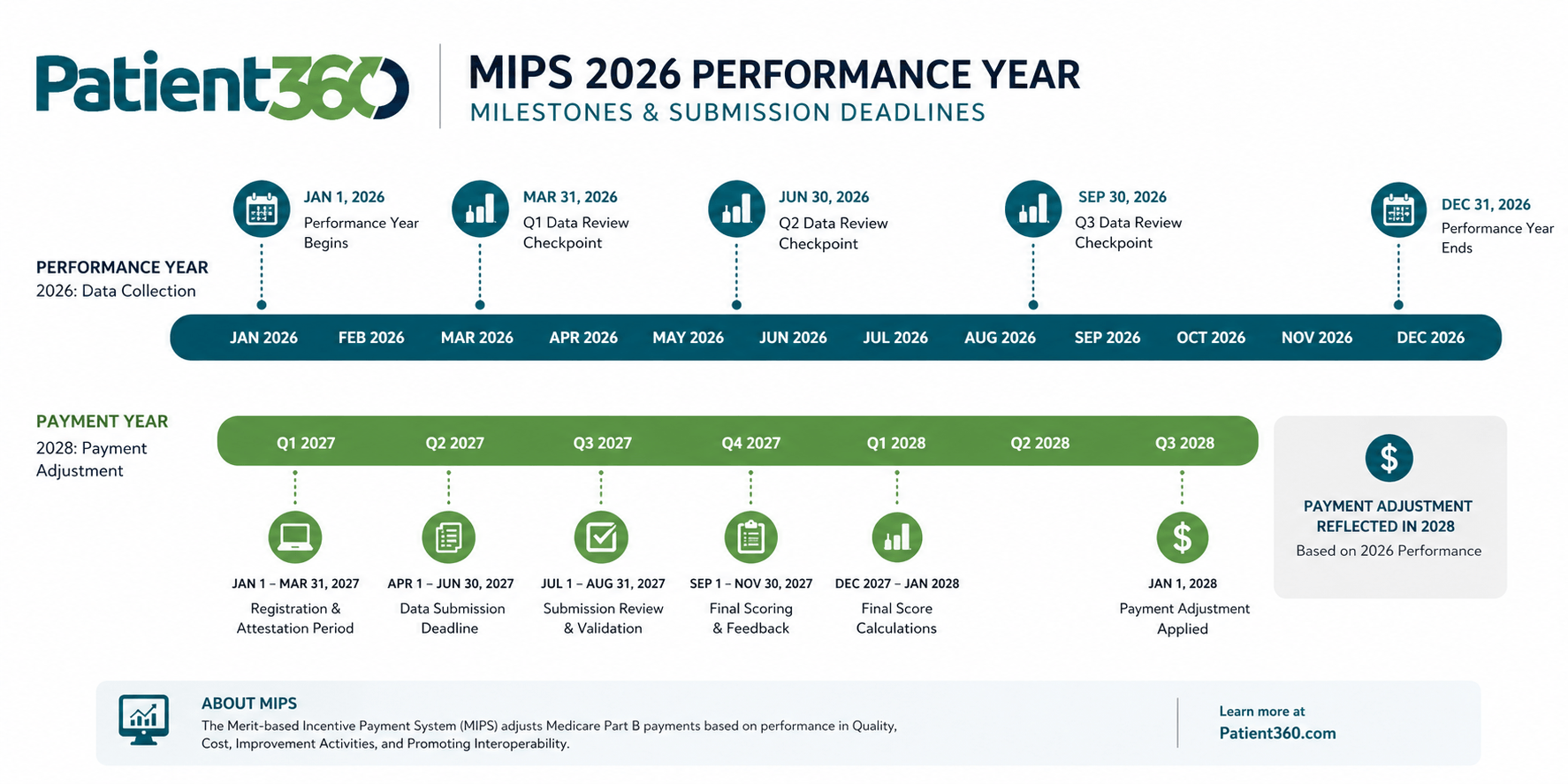
The 2026 MIPS performance year spans January 1 to December 31. Data submission typically occurs between January and March 2027; missing this window results in a mandatory negative payment adjustment if you are eligible for MIPS.
Early preparation is vital, as some methods, like using a MIPS Qualified Registry, require advance setup. Selecting measures and establishing data flows early prevents year-end stress and ensures data completeness.
Practical Steps to Take Right Now
The clinicians and practices that do best in MIPS aren’t necessarily the ones with the highest patient volume or the fanciest EHR. They’re the ones that start early, stay organized, and pick the right measures for their specific situation. Here’s where to focus:
- Review the 2026 QPP policy changes now. CMS has published finalized updates to the 2026 QPP policy changes, and reading through the highlights will save you from surprises later.
- Audit your current quality measures. Which ones are you capturing well? Which ones have you been struggling with? 2026 is a good year to drop low-performing measures and replace them with ones that reflect your actual clinical workflow.
- Check your EHR configuration. Make sure your system is pulling the data you need for Promoting Interoperability and that your reporting connections are active.
- Map your Improvement Activities. Look at what your practice already does that might qualify. Many common care coordination or patient engagement efforts already meet the requirements.
- Stay current on MIPS updates for 2026 from trusted sources so you’re not caught off guard by late changes to benchmarks or measure specifications.
Why MIPS 2026 Preparation Matters
The stakes are real. A positive MIPS adjustment can meaningfully boost your Medicare reimbursements, while a negative adjustment can cut into margins that are already under pressure.
All the details around preparing for MIPS 2026 come down to one thing: having a clear plan before the year gets away from you. The practices that struggle usually aren’t doing anything wrong clinically. They just didn’t build a reporting process that could keep up with what CMS requires.
Exploring your options through Patient360’s MIPS reporting services is a practical way to simplify that process, get access to over 200 eCQMs, CQMs, and QCDR measures, and make sure your data is accurate before the submission window opens.
Start Strong, Finish Stronger
2026 doesn’t have to be a scramble. The updated requirements are manageable if you approach them methodically, choose your measures strategically, and build your reporting workflow before the year gets into full swing. The worst thing you can do is wait and hope it works out, because with MIPS, there’s very little room for that.
Take the time now to review your categories, understand the MVP landscape, and make sure your technology is doing what it needs to do. Your future reimbursements will thank you.